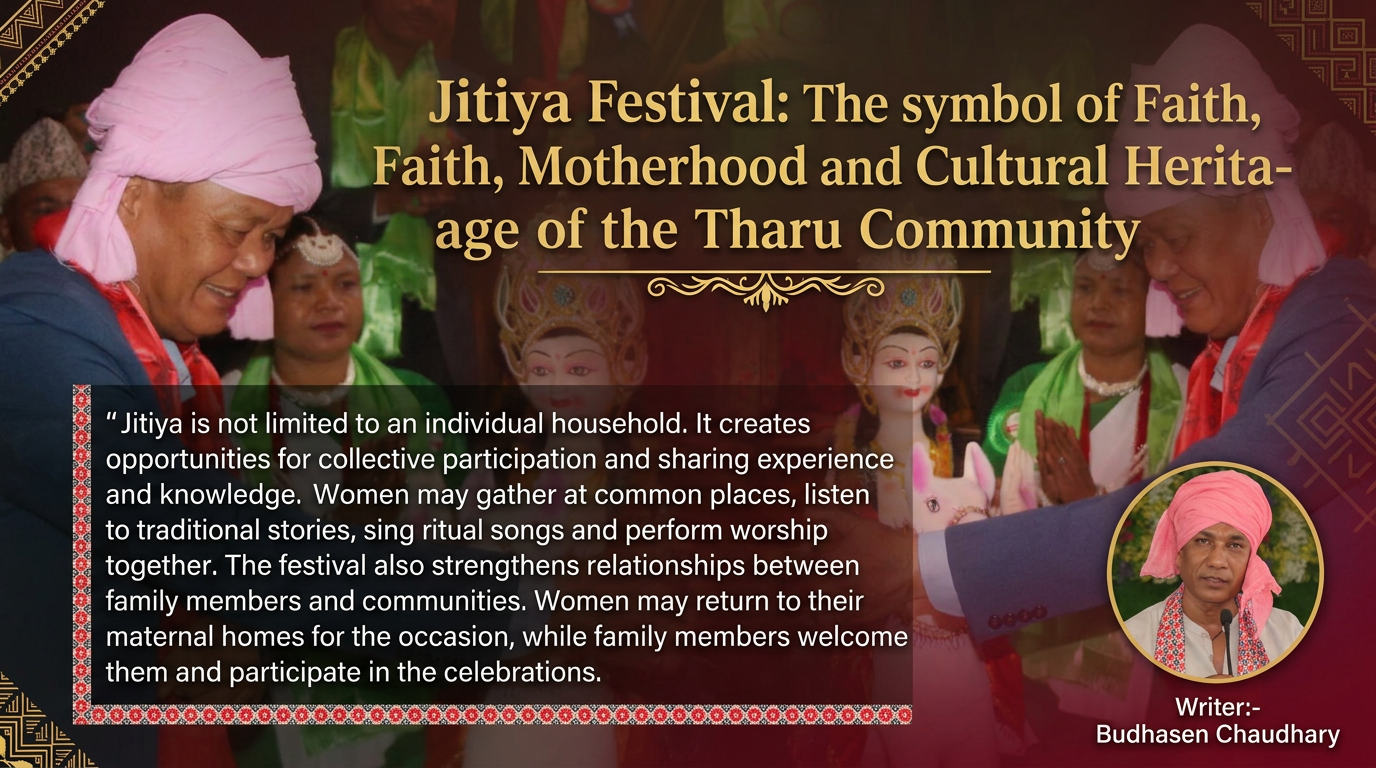
Jitiya Festival: The symbol of Faith, Motherhood and Cultural Heritage of the Tharu Community
Jitiya is not limited to an individual household. It creates opportunities for collective participation and sharing experience and knowledge. Women may gather at common places, listen to traditional stories, sing ritual songs and perform worship together. The festival also strengthens relationships between family members and communities. Women may return to their maternal homes for the occasion, while family members welcome them and participate in the celebrations.
Jitiya festival, one of the important traditional festivals of the Tharu community, is a festival deeply rooted in faith, motherhood, family, and cultural identity. It is primarily observed by married women who undertake a rigorous fast and perform rituals for the long life, good health, courage, prosperity, and success of their children. It makes a strong connection between brother and sister or we may say It improves the relationship between a woman's maternal home and her in-laws' home.
The festival is dedicated to Jitmahan Baba (जितमहान बबा). The word Jit refers to victory, while Mahan means great. According to the traditional belief preserved in the Tharu community, Jitmahan is connected with the Sun God (सुरुज भगवान), and his mother is known as Masawasi (मसवासी). The festival is therefore not simply a religious observance; it is also an expression of a mother's unconditional love and hope for the well-being of her offspring.
Faith and Motherly Love
Jitiya festival generally falls and is observed during the waning phase of the month of Ashwin, particularly on the seventh, eighth, and ninth lunar days. The seventh day is associated with Lai (लाई) that is the begain of ritual fast by bathing, the eighth with the main fasting day or Upas (उपास), and the ninth with Paran (पारन), when the fast is formally concluded.
Women observe the fast with great care and devotion. According to the traditional belief, the fast should not be broken. Certain forms of ritual impurity or interruption, locally understood through concepts such as Chhutuk (छुतुक) or Bhirakho (भिर्खो), are believed to affect the observance of Jitiya.
The emotional significance of the festival can be seen in a traditional saying:
“Jitiya Pabain Bar Bhari, Dhiya Puta Ke Thoik Sutabe, Apna Lya Bhair Thari.”
The saying reflects the importance given to children and the sacrifices made by mothers for their protection and well-being.
Story of Jitmahan
One of the central traditions of Jitiya is the story of Jitmahan Baba. According to the traditional belief and narrative, King Salibahan (सालिवहान)had a daughter named Masawasi (मसवासी). She chose a life devoted to worship and lived in a simple hut rather than following an ordinary married life. One day, a ray of the Sun touched her, and she became pregnant. She gave birth to a son. Her son, Jituwa, grew up to be extraordinarily courageous and victorious.
When his classmates questioned him about his father, Jituwa asked his mother. Masawasi told him that his father was Surya Bhagwan, the Sun God. Jituwa then went in search of Surya. When Surya appeared before him, he blessed him and declared that married women who sincerely observed Jitiya festival would be blessed with children who were healthy, long-lived, courageous, and successful. This story forms an important spiritual foundation of the festival and explains why mothers place such great faith in the Jitiya fast.
Story of Chilhaur (चिल्हौर) and Siyar (सियार)
Another important story associated with Jitiya is the story of Chilhaur and Siyarni, two animal friends. Both live in a pakair tree. Both observed the Jitiya ritual. However, Siyarni broke her fast by eating the flesh of a dead person, while Chilhaur remained faithful to the fast. In their next birth, the two were born as sisters named Somta and Bemta. Somta's children survived and prospered, while Bemta repeatedly experienced the death of her children. Eventually, the connection between their previous lives and the consequences of their Jitiya observance became known.
This story reinforces the traditional belief that sincerity, discipline, and faith are essential parts of the Jitiya fast. More importantly, it represents the community's belief in the relationship between actions, moral conduct, and the well-being of future generations.
Jitiya follows a distinctive sequence of rituals; Lai(लाई), Otghan (ओटघन), Upas (उपास) and Paran (पारन)
Lai (लाई)
On the first day, women bath in a pond, river, or another water source. They clean their homes and worship Surya Bhagwan and Jitmahan. The place of the household deity is also cleaned and prepared for the festival.
Otghan (ओटघन)
Before beginning the rigorous fast, women traditionally take Otghhan, a special meal prepared according to family and local traditions. The meal may include yam, fish or vegetarian dishes, rice, lentils, vegetables, milk, curd, beaten rice, bananas and other fruits.
Before eating, women perform the prescribed ritual for Chilhī and Siyarni. This meal is considered an important preparation for the following day of fasting.
Upas(उपास)
The eighth day is the main fasting day. Women observe the fast without food and, according to the traditional practice described in the Tharu source, participate in collective worship at a pond, riverbank, or a specially prepared place when a natural water source is unavailable.
Devotees carry a Daliya (डलिया), a collection of ritual materials, and participate in the worship and narration of the Jitmahan story. In many places, women gather collectively and perform the rituals under the guidance of a traditional priest or Dhami.
Paran (पारन)
The ninth day(नमी तिथी) is the day of breaking the fast. Traditionally, it is performed around sunrise after completing the required household rituals and offerings.
The ritual includes symbolic consumption of Ankuri (अंकुरी) and Akshat (अछत) with water, followed by foods such as curd, beaten rice, molasses, and bananas. Ritual materials may then be taken to a pond or river and immersed.
Ritual Materials and Connection with Nature
Jitiya is also closely connected with the natural environment and agricultural life of the Tharu community. The rituals use locally available plants, flowers, leaves, grasses, fruits, grains, clay, oil, vermilion, incense, lamps, betel nuts, coconuts and other traditional materials.
Among the materials mentioned in the tradition are Bikhman leaves, Jitiya flowers, Kachnar flowers, Ghera leaves and flowers, Tulsi, Makathi, Laru, new rice, banana stalks, Pakair branches, Ankuri and Akshat or others. This extensive use of natural and locally available materials demonstrates how traditional Tharu cultural practices have historically remained closely connected with land, water, agriculture and biodiversity.
Community, Culture and Celebration
Jitiya is not limited to an individual household. It creates opportunities for collective participation and sharing experience and knowledge. Women may gather at common places, listen to traditional stories, sing ritual songs and perform worship together.
Traditional cultural performances such as Sauraiṭhi (सोरठी), Maan (मान) and Jhamṭa (झमटा) and others have also been associated with the festive atmosphere. In contemporary settings, traditional forms of entertainment may exist alongside modern forms such as films, dramas and videos.
The festival also strengthens relationships between family members and communities. Women may return to their maternal homes for the occasion, while family members welcome them and participate in the celebrations.
More Than a Religious Festival
Jitiya festival is more than a fasting ritual. It is a living expression of the Tharu community's cultural heritage. At its heart is a mother's hope for the safety and future of her children. Around that central idea has developed a rich tradition of stories, songs, rituals, natural materials, food practices, community gatherings and intergenerational knowledge.
The stories of Jitmahan, Masawasi, Chilhaur and Siyar preserve traditional ideas about courage, devotion, discipline, morality and family responsibility. The rituals connect people with nature and community, while the collective celebration keeps cultural knowledge alive.
As Tharu communities experience social, economic and technological change, festivals such as Jitiya provide an important opportunity to preserve and transmit cultural knowledge from one generation to the next. Now, it is a time for all the Women and parents to pray Jeetmahan by enhancing the capacity of their offspring through education and digital technology.
Jitiya therefore stands as a powerful symbol of faith, motherhood, cultural continuity and the enduring identity and civilization of the Tharu community as well as other community live in Tharuhat terai.
-The author Budhasen Chaudhary is a scholar of Tharu culture
आधुनिकताका नाममा परम्परागत संस्कृति विर्सनु हुँदैन
बिहीबार, माघ २९, २०८२
दुर्गमका महिला पत्रकार : क्षमता विकासमा सरोकारवाला र राज्यको दायित्व
आइतबार, पुस १३, २०८२